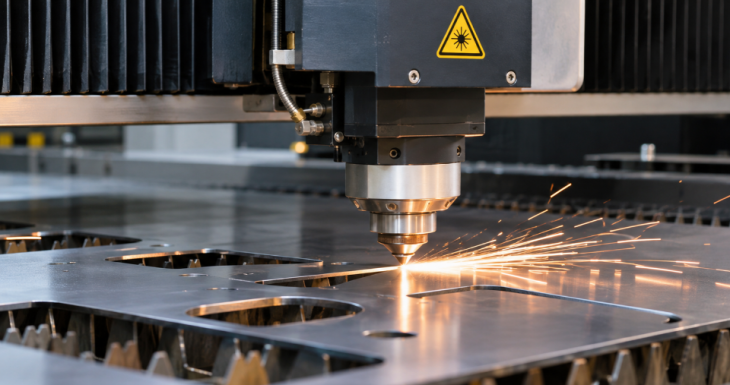
A setting that works well for carbon steel may not produce the same result when cutting stainless steel or aluminium. Even two sheets of the same thickness may require different settings.
The key lies in interpreting the cut result and knowing which parameters to check when burrs, slag, uneven edges or incomplete cuts occur.
What factors determine the quality of laser cutting of sheet metal
The quality achieved with an industrial sheet metal laser depends on several interrelated parameters:
- sheet metal material
- thickness
- power output
- cutting speed
- assist gas
- gas pressure
- focus position
- type and condition of the nozzle
- beam centring
- distance between the nozzle and the sheet metal
- surface condition of the material
A cutting defect should not automatically be attributed to a lack of power. Before adjusting this parameter, it is advisable to check what has changed compared to a previous job that produced a good result.
The material and thickness affect the required parameters
Each material responds differently to the cutting process.
Carbon steel, stainless steel and aluminium should not be processed using a single set of settings. Changing the material or increasing the thickness may also alter the required speed, gas, pressure and focal position.
Thickness is particularly important because it affects the amount of material the beam must penetrate and the conditions required to correctly eject the molten material from the kerf.
Therefore, cutting parameters must be set for a specific combination of material, thickness and process, and not solely based on the machine’s kilowatt rating.
Which gas to use for laser cutting of sheet metal
The assist gas plays a direct role in the removal of molten material and in determining the characteristics of the cut edge.
In industrial applications, oxygen and nitrogen are mainly used, although certain machines also allow for the use of compressed air or other gases.
Nitrogen is used when the aim is to achieve an edge without significant oxidation, which may be important if the workpiece is to undergo further processing.
Oxygen plays an active role in the process when cutting carbon steel and allows a different cutting mechanism to be used to that employed with inert gases.
The choice should not be based solely on cost or speed. It is necessary to assess the material, thickness, required finish and any further processing the workpiece will undergo.
More power does not automatically mean better quality
The available power determines part of the machine’s capacity, but does not in itself guarantee a good finish.
The power applied must be in proportion to the feed rate and the other parameters.
If the feed rate is too high for the working conditions, cutting problems or increased burr formation may occur. A feed rate that is too low can also impair the finish.
Therefore, when seeking to improve quality with an industrial sheet metal laser, power and feed rate must be analysed together.
Why the focus and the nozzle are so important
The position of the focus determines where the energy is concentrated in relation to the sheet metal.
Its setting may vary depending on the material, thickness and cutting process. An incorrect position can affect the stability of the process and the appearance of the edge.
The nozzle also warrants attention. Its condition, diameter, alignment and distance from the sheet metal all affect the flow of the assist gas.
If a workpiece begins to show defects without any change in material, thickness or programme, it is advisable to check these elements before altering numerous process parameters.
What to check depending on the type of cut
The appearance of the edge can help guide the initial diagnosis.
|
Problem observed |
What to check |
|---|---|
|
Burr or slag on the underside |
Speed, gas, pressure, focus and nozzle |
|
Incomplete cut |
Speed, power output, focus, gas flow and thickness |
|
Irregular edge |
Focus, speed, process stability and surface |
|
Differences within a single piece |
Nozzle, centring, material and parameters |
| Progressive decline in quality | Nozzle, optics, focus and process conditions |
There is no one-to-one correspondence between a defect and its cause. The same burr may arise for different reasons, so it is advisable to adjust the parameters in a controlled manner and check the result of each change.
How to achieve consistent results across jobs
When a configuration produces the correct result, recording the conditions provides a reference for future jobs.
It is advisable to record at least the following:
- material and grade
- thickness
- power used
- speed
- gas
- pressure
- focus position
- nozzle used
- cutting result
Keeping this record allows you to compare similar jobs and identify more quickly which parameter has changed when the finish is not as expected.
If you are looking for a general explanation of technologies, how the equipment works and the different types of machinery, you can consult our guide to industrial laser cutting machinery.
Frequently asked questions about industrial sheet metal lasers
Why might two sheets of the same material and thickness be cut differently?
Because the material designation and thickness do not describe all the material’s characteristics. The surface condition, any coatings, the quality of the sheet metal and differences between batches can all affect behaviour during cutting. If a job’s results change without any changes to the programme, it is also advisable to check the material.
What does it mean if a burr appears on the underside of the cut?
It means that the process is not removing the molten material as intended. Before adjusting the power, it is advisable to check the speed, gas, pressure, focus, condition of the nozzle and material conditions.
When is it advisable to use nitrogen instead of oxygen?
Nitrogen is particularly useful when it is necessary to prevent oxidation at the cut edge. This may be important when the workpiece is to undergo further treatments or processes where the condition of the cut edge is significant. The final choice depends on the material, thickness and required finish.
Why might the cut quality deteriorate if the programme has not been changed?
Because the programme is only one part of the process. A damaged or misaligned nozzle, changes to the focal point, dirt on optical components, variations in the sheet metal or fluctuations in the gas supply can all affect the result, even if the saved parameters remain the same.
Controlling the process makes all the difference
Working effectively with an industrial sheet metal laser requires more than just sufficient power.
Quality depends on the combination of material, thickness, speed, gas, pressure, focus and the condition of the cutting elements. Systematically checking these variables makes it easier to identify the cause of defects and maintain more consistent results from one job to the next.
If you need to incorporate laser technology into your production, you can browse our range of new industrial machinery, view our second-hand laser equipment or contact Maquinaria Barriuso.