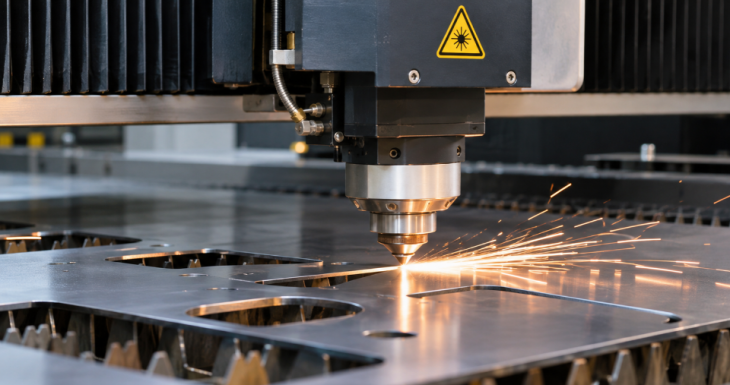
An industrial punching machine uses a punch and die to make holes or perform selected forming operations. Depending on machine configuration and tooling, it can process sheet metal, flat bars and structural profiles.
Choosing the right machine requires understanding material properties, thickness, hole geometry and production requirements.
Define your punching requirements
- Material: carbon steel, stainless steel, aluminium or other alloys.
- Thickness: minimum and maximum workpiece thickness.
- Geometry: hole dimensions, shapes and locations.
- Production: occasional jobs or repetitive manufacturing.
- Tooling: required punch and die sizes.
- Automation: positioning and programming requirements.
These factors help determine whether a universal punching machine or a CNC turret punch press is more suitable.
Need to punch profiles or flat bars? Explore our used industrial machinery.
Types of industrial punching machines
Hydraulic punching machines
Use hydraulic force to drive the punch. Hydraulic ironworkers may combine punching, shearing and notching stations for metal fabrication work.
Mechanical punching machines
Use a mechanical drive system. Their suitability depends on force capacity, stroke, tooling and production rate.
CNC turret punching machines
Use numerical control to position sheet metal and select tools for programmed operations. CNC describes the control system, not necessarily the drive technology.
Before comparing prices, establish whether your work involves structural profiles or programmable sheet metal punching.
Comparison of punching machine configurations
| Machine | Typical use | Key specifications |
|---|---|---|
| Hydraulic ironworker | Profiles, flat bars and fabrication. | Force, throat depth and stations. |
| Mechanical punch | Repetitive punching with dedicated tooling. | Stroke, drive and cycle rate. |
| CNC turret punch | Sheet metal with multiple holes and shapes. | Work area, tooling and controls. |
How much punching force is required?
Punching force depends on the cut perimeter, material thickness and shear strength.
For an approximate simultaneous cut, cutting force ≈ cutting perimeter × material thickness × shear strength. With perimeter and thickness in millimetres and shear strength in N/mm², the result is expressed in newtons.
Actual machine selection must also consider tooling, operating conditions and manufacturer specifications.
Know your hole dimensions and material? Use them to verify the required machine capacity.
What is punch-to-die clearance?
Die clearance is the gap between the punch and die cutting edges. It affects cutting force, edge quality, burr formation and tool wear.
The punch dimensions relate to the required hole geometry. Clearance must be selected according to material, thickness and tooling recommendations. The punch thickness does not have to equal the sheet thickness.
Buying a used machine? Check which punches and dies are included and whether replacements are available.
Technical specifications to compare
| Specification | What to check |
|---|---|
| Rated force | Capacity for the required material and hole geometry. |
| Throat depth | Usable reach into the workpiece. |
| Stroke | Movement required for punching. |
| Tooling | Compatibility and replacement cost. |
| Production | Cycle rate and material handling. |
| Controls | Manual positioning or CNC functions. |
Need help comparing specifications? Contact Maquinaria Barriuso with your workpiece details.
What to inspect when buying a used punching machine
Check the frame, drive system, punch alignment, tooling condition, controls, safety devices and available documentation. Where possible, carry out a punching test on representative material.
Transport, installation and applicable safety requirements should also be assessed.
Looking for second-hand equipment? Browse our used machinery catalogue.
Frequently asked questions
What is the difference between an ironworker and a CNC turret punch?
An ironworker commonly handles profiles and flat bars. A CNC turret punch is designed for programmed sheet metal operations.
Can stainless steel be punched?
Yes, when machine force and tooling are suitable for the material and thickness.
Does nominal force alone determine the maximum hole diameter?
No. Material strength, thickness, hole perimeter and tooling also matter.
Find an industrial punching machine at Maquinaria Barriuso
Choose your punching machine according to force, material, workpiece geometry and production volume.
View our used machinery or contact our team to discuss available punching equipment.