

Do you want to improve precision and efficiency in your industrial processes? Parallel lathes are essential tools in any workshop or factory. In this article, you'll discover what they are, their main features, applications, and the benefits of choosing a second-hand model.
What is a parallel lathe and what is it used for?
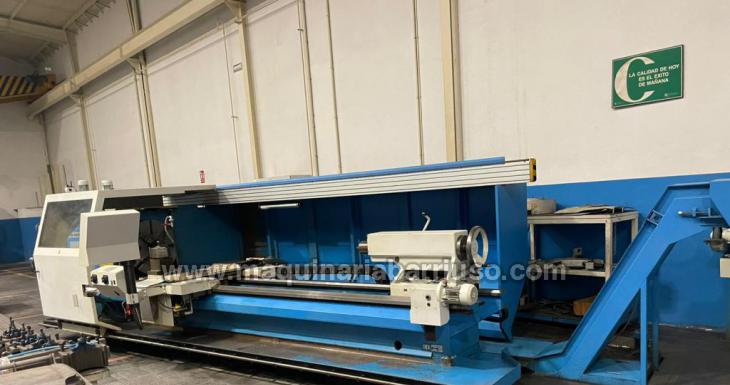
A parallel lathe is a machine tool designed to shape materials such as metal, plastic, or wood. Its name comes from the parallel movement between the spindle and the workpiece during the cutting or turning process.
Main features of the parallel lathe
- Versatility: Suitable for a wide range of materials.
- Precision: Allows the creation of cylindrical, conical, and threaded parts with high accuracy.
- Advanced control: Offers precise adjustments in speed, depth of cut, and feed.
- Durability: Designed to withstand long working hours.
What is a parallel lathe used for?
- Manufacturing industrial parts: From shafts and gears to custom components.
- Repair: Ideal for restoring worn-out parts.
- Prototyping: Useful for developing new products and testing designs.
Main parts of a parallel lathe and their function
A parallel lathe consists of several essential components that work together to ensure efficient operation:
- Main spindle: Holds and rotates the workpiece.
- Cross slide: Allows the cutting tool to move perpendicularly to the axis of the workpiece.
- Tailstock: Supports the workpiece from the opposite end of the spindle.
- Gearbox: Controls the rotation speed.
- Tool turret: Holds cutting tools and facilitates quick tool changes.
How a parallel lathe works
The operation of a parallel lathe involves the following steps:
- The workpiece is secured in the main spindle.
- The cutting tool is adjusted in the tool turret.
- The cutting speed and depth are configured.
- The tool moves parallel to the axis of the workpiece as it rotates, removing material and creating the desired shape.
Benefits of acquiring a second-hand parallel lathe
- Economic savings: Reduces costs without compromising quality.
- Immediate availability: Avoids long waiting times.
- Proven performance: Machines with a tested history of efficiency.
Types of parallel lathes
1. Conventional parallel lathes:
- Manually operated.
- Ideal for small workshops or custom work.
2. CNC parallel lathes:
- Computer-controlled.
- Enable automated processes and improve precision in series production.
Applications of parallel lathes
- Metallurgical industry: Manufacturing components such as shafts and threads.
- Automotive: Production of mechanical parts and prototypes.
- Precision mechanics: Creation of specialized tools and molds.
Find the ideal parallel lathe at Maquinaria Barriuso
Parallel lathes are an essential tool for any company seeking efficiency, precision, and versatility. If you're considering acquiring one, opting for a second-hand parallel lathe can be an economical and strategic decision.
At Maquinaria Barriuso, we offer a wide variety of parallel lathes tailored to your needs. Contact us to receive expert advice and ensure you find the perfect machine for your projects.