


Are you looking to improve your workshop's productivity and wondering whether to choose a hydraulic press brake or a CNC press brake? Both are common options in the metal industry, but they don’t offer the same features. Here we explain what they are, how they work, their differences, advantages, disadvantages, and what to consider before investing in one or the other.
Additionally, we’ll show you the models available at Maquinaria Barriuso so you can find the one that best suits your production needs.
What is a hydraulic press brake?
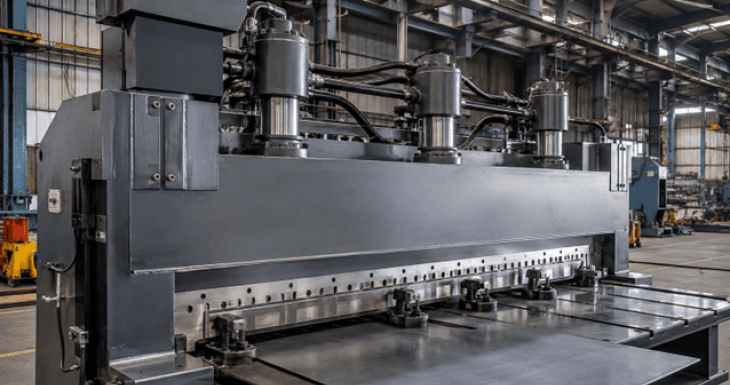
A hydraulic press brake is a machine that uses hydraulic force through pistons to bend metal sheets. This system ensures great power, precision, and repeatability, making it ideal for working with materials of different thicknesses and sizes.
Advantages of a hydraulic press brake
- Excellent force capacity for thick materials.
- Consistent precision thanks to hydraulics.
- More affordable than a CNC for standard jobs.
- Reliable and durable for medium-scale productions.
Disadvantages
- Less flexible for quick production changes.
- Requires operator experience to achieve exact precision.
- Slower and more manual adjustments than with a CNC.
What is a CNC press brake?
A CNC (Computer Numerical Control) press brake allows you to automate and store all bending parameters through software. This results in very high precision, repeatability, and speed. It’s the ideal option for series production, complex jobs, and parts requiring maximum accuracy.
Advantages of a CNC press brake
- High precision and repeatability.
- Automates processes and reduces human error.
- Saves time on repetitive series.
- Enables complex bending in less time.
- Easy management of different programs and parts.
Disadvantages
- Higher initial investment.
- Requires basic training in CNC software.
- More complex to maintain in the long term.
Main differences between hydraulic and CNC
| Aspect | Hydraulic Press Brake | CNC Press Brake |
| Control | Manual and semi-automatic | Fully automated via software |
| Precision | High (requires experience) | Maximum, thanks to digital control |
| Production | Medium, adaptable | High, repetitive, and fast |
| Initial cost | More economical | Higher investment |
| Flexibility | Less agile for changes | Highly flexible |
| Complexity | Less complex, more manual | Requires CNC training |
What to consider when choosing your press brake
Before making a decision, consider the following points:
- Production volume: If you run many repetitive series, go for CNC.
- Type of parts: If you work with unique pieces or small batches, hydraulic may be enough.
- Required precision: CNC is superior if you need consistent millimetric finishes.
- Budget: Hydraulic is more affordable for getting started.
- Staff training: CNC requires basic technical knowledge.
Types and models you'll find at Maquinaria Barriuso
At Maquinaria Barriuso, we work with a wide range of industrial press brakes, both hydraulic and CNC:
Hydraulic Press Brakes
Ideal for workshops looking for robustness, reliability, and good value for money.
Available examples:
• Hydraulic press brake MVD D320/6100 – 6100 x 320 Tn
• Hydraulic press brake MVD B135/3100 – 3100 x 135 Tn
• Hydraulic press brake DURMA Mod. HAP 30160
Recommended uses:
- Metal workshops.
- Structure manufacturers.
- Boilermaking.
CNC Press Brakes
Perfect for demanding productions looking to optimize time and reduce errors.
Available examples:
• CNC from 3 m x 90 tn. to 16 m x 3000 tn
Available capacities:
• From 3 meters x 90 tons
• Up to 16 meters x 3,000 tons
Recommended uses:
• Series production.
• Parts with complex bends.
• Industries needing maximum efficiency.
Which option is better for you?
- If your work requires adapting to variable projects, unique parts, or moderate productions, the hydraulic press brake may be sufficient.
- If your goal is to automate, reduce time, and ensure perfect precision in all your parts, the CNC press brake is the best investment.
At Maquinaria Barriuso, we provide advice to help you choose the right machine for your production needs, with new, second-hand, and refurbished options.
Frequently Asked Questions (FAQ)
- What’s the difference between a hydraulic press brake and a CNC one?
CNC offers greater precision and automation thanks to its computer control. The hydraulic is simpler and more manual, but very reliable.
- Which press brake is better for starting a workshop?
If it’s a small or medium workshop, a hydraulic press brake is usually sufficient. If you already work in series or need maximum precision, go for CNC.
- Are CNC press brakes harder to use?
No. With basic training, they are easy to operate, and many current models are intuitive.
- Can I find second-hand press brakes?
Yes, at Maquinaria Barriuso we offer inspected and guaranteed used hydraulic and CNC press brakes.
- What maintenance is required?
Hydraulic machines require oil system checks and mechanical adjustments. CNCs also require software maintenance and calibration.
Looking for your new press brake?
Visit our section of new industrial press brakes and used ones to find the best solution for your business.
At Maquinaria Barriuso, we help you make the right choice.
If you need guidance to choose your press brake machine, contact us. We’ll help you find the most efficient option according to your production needs.