Imagine a machine capable of machining parts with millimetric precision, without direct operator intervention, repeating the same process as many times as necessary, and working at a pace that would be impossible to achieve manually. This type of manufacturing is already part of daily operations in sectors such as automotive, aerospace, electronics, carpentry, and molds thanks to CNC milling machines.
These machines have raised quality, speed, and efficiency in industrial production. From Maquinaria Barriuso, specialists in new and second-hand industrial machinery, we clearly analyze what they are, how they work, and why they have become a key component of modern manufacturing.
What a CNC Milling Machine Is
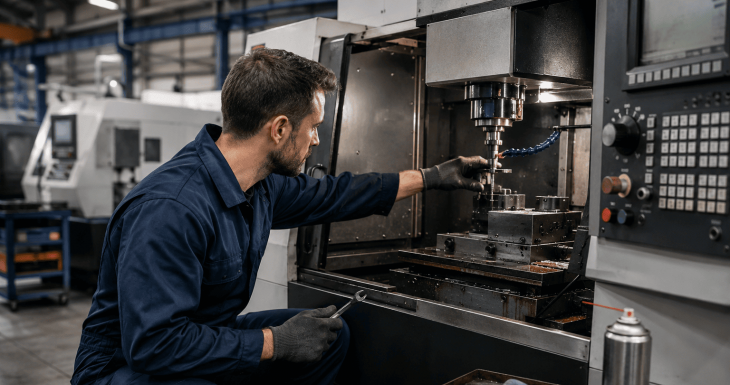
A CNC milling machine (Computer Numerical Control) is a machine tool designed to cut, drill, and shape materials through digital commands. Instead of relying on manual movements, the milling machine executes programmed paths that guide the cutting tool with far superior accuracy.
The part is designed in CAD software, translated into G-code through CAM software, and the CNC controller interprets the instructions. With this method, the process is more stable, errors are reduced, and the same quality is maintained in all units.
At Maquinaria Barriuso you will find CNC milling machines both new and second-hand, ready to work in environments where precision is a constant requirement.
Main Components of a CNC Milling Machine
Although there are various models and configurations, most CNC milling machines share a series of key elements that determine their machining capacity.
- Spindle: the motor that rotates the cutting tool. Its speed and rigidity directly influence the quality of the finish.
- Worktable: the surface where the material is fixed. Its dimensions determine the maximum size of the part that can be machined.
- Motors and guides: responsible for the machine’s movement along the X, Y, and Z axes. A good combination of motors and linear guides allows smooth and precise movements.
- CNC controller: interprets the programming code and translates it into movements, tool changes, stops, and automatic cycles.
- CAD/CAM software: programs used to design the part and generate the G-code that the milling machine will use during machining.
How CNC Milling Machines Have Changed the Industry
Constant Precision Even in Long Series
The CNC repeats the same movement with total fidelity, without appreciable deviations. This is essential in sectors such as automotive or aerospace, where each part must meet very strict tolerances to ensure safety and proper performance.
Less Material Waste
Trajectory programming allows maximum use of each block of material. The tool covers only the necessary areas, reducing excess and lowering the cost of each manufactured unit.
Higher Production Speed
CNC milling machines can work for prolonged cycles at a constant pace. This continuity allows orders to be delivered in less time and larger series to be produced without increasing the number of machines.
Advanced Design and Fewer Manual Operations
Many parts that previously required several machining stages are now produced in a single milling machine. With a good 3D model and a well-planned CAM strategy, the operator can go from design to finished part with very little manual intervention.
Applications of CNC Milling Machines in Modern Industry
The versatility of CNC milling machines means they are present in numerous sectors. Some of the most common uses include:
- Automotive: machining of engine blocks, cylinder heads, gearboxes, tooling, and molds for plastic or aluminum injection.
- Aerospace: production of lightweight and stable components for fuselages, turbines, and structural systems subjected to high stress.
- Medical: manufacturing of prosthetics, surgical guides, and parts for hospital equipment that require great precision.
- Carpentry and design: creation of furniture, decorative panels, structural elements, and customized projects in wood or derivatives.
- Electronics: machining of housings, heat sinks, connector enclosures, and other components for technological devices.
The Future of CNC Milling Machines
The development of new technologies continues to drive improvements in CNC milling machines. The goal is to achieve more autonomous machines, with less downtime and better adaptation to each type of production.
Integration with Artificial Intelligence
The combination of CNC and artificial intelligence allows real-time adjustment of cutting parameters, detection of abnormal vibrations, and anticipation of maintenance before a breakdown occurs.
IoT Connectivity on the Shop Floor
Thanks to the Internet of Things (IoT), the milling machine shares data with other equipment in the factory. This facilitates production control, shift planning, and performance monitoring.
Hybrid Machining and New Techniques
The fusion of CNC milling with processes such as additive manufacturing or advanced grinding opens the door to more complex parts, with fewer machine changes and less downtime.
New and Second-Hand CNC Milling Machines at Maquinaria Barriuso
Choosing the right machine is an important decision for any company. At Maquinaria Barriuso we offer a wide catalog of new CNC milling machines and second-hand CNC milling machines that are suitable for both small workshops and intensive production plants.
New CNC milling machines offer the latest improvements in control, energy savings, and cycle times. They are an appealing solution for companies needing high availability, advanced connectivity, and up-to-date programming functions.
Second-hand CNC milling machines undergo a complete inspection by our technicians. Spindles, guides, electronic systems, and safety features are checked to ensure the machine is ready to join the production line with confidence and at a much more affordable investment cost.
We analyze with you the type of part you manufacture, the expected production volume, the materials you use, and the available space in your workshop to recommend the model that best suits your situation.
Frequently Asked Questions About CNC Milling Machines
Is a lot of experience needed to operate a CNC milling machine?
Training in programming and safety is necessary, but with proper training an operator can learn to work with the machine and improve with practice. Many companies combine basic courses with support during the first projects.
Can CNC milling machines work with hard materials?
Yes. With the right tool it is possible to machine alloy steels, stainless steels, aluminum, titanium, or technical plastics. The key is properly choosing the type of insert, cutting parameters, and part clamping.
Is investing in a second-hand CNC milling machine worthwhile?
It can be a good decision if the budget is limited or if you want to increase capacity without making a large initial investment. It is always advisable to purchase it from a supplier that inspects and guarantees the machine’s condition, such as Maquinaria Barriuso.
What factors influence the price of a CNC milling machine?
The size of the table, axis travels, spindle power, number of controlled axes, type of CNC control, and level of automation are some of the aspects that most influence the final cost.
Can a CNC milling machine be adapted to new parts over time?
Yes. It is only necessary to create new programs in the CAD/CAM software. This adaptability allows the same machine to work on different parts throughout its useful life without changing equipment.
Take the Next Step With Your Production
CNC milling machines have become a key ally for any company that wants to improve precision, reduce lead times, and maintain a consistent level of quality in all its parts. Choosing the right machine and supplier makes the difference between a profitable investment and a limited production line.
If you are considering incorporating a CNC milling machine or renewing your machinery fleet, you can contact Maquinaria Barriuso through our contact form. We will help you analyze your needs and choose the most suitable solution for your company.